
The Story of Khmer New Year
A folktale told throughout Cambodia
A folktale about the origins of Khmer New Year, the Cambodian New Year festival.
Cambodians still hold dear the idea of heaven, earth and hell, and the belief that good deeds lead to happiness in the next life. Khmer New Year, a three-day festival celebrated every year in mid-April, also comes with a legend like this.
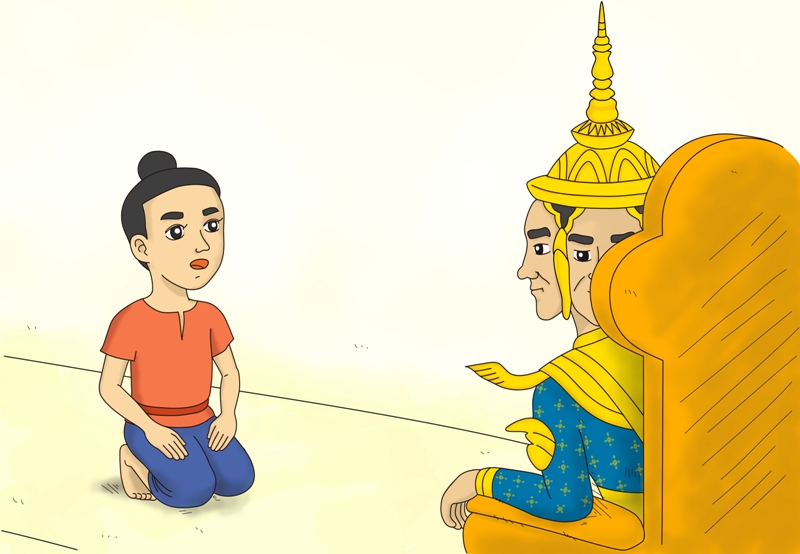
Long ago there lived a learned young man named Thommabal Kumar. He had mastered every field of study and could even understand the language of birds, and in time word of him reached the ears of Kabel Moha Prohm, king of the gods. Jealous, the king came down to earth and challenged him to a contest of riddles: whoever lost would give up his head.
The riddle was three questions: "Where is happiness in the morning, at midday and in the evening?" After six days of thinking he still had no answer. In despair, Thommabal lay resting, exhausted, deep in the forest, when he overheard a pair of vultures, husband and wife, talking.
Boasting that they would feast on Thommabal's flesh tomorrow and the day after, the husband vulture proudly told his wife the answers to the riddle. In the morning, happiness is in the "face," which people wash; at midday, in the "chest," which they cool with water; in the evening, in the "feet," which they wash at the end of the day. Hearing this, Thommabal hurried home overjoyed.
On the seventh day, Kabel Moha Prohm came for the answers and was astonished when Thommabal answered correctly. Following the rule he himself had set, the king resolved to cut off his own head.
Before doing so, he called his seven daughters and told them: "If this head is thrown onto the earth, the earth will burn; if it is thrown into the sky, there will be storms; if it is thrown into the sea, the sea will dry up. So place it on a golden tray and guard it with care." Then he cut off his own head.
The eldest daughter, Tungsa Tevi, held up the tray bearing the king's head and, together with her six sisters and countless angels, walked in procession around the sacred Mount Sumeru for an hour. Afterward, it is said, the head was laid to rest for a time on Mount Kailash.
In time the angels returned to heaven. But ever since, on the same day every year, the seven daughters come down to earth as angels and carry the tray with their father's head in procession around Mount Preah Sumeru. This is the legend handed down with Khmer New Year.
The end.
About this story
This legend is told throughout Cambodia as the origin of Khmer New Year (Chaul Chnam Thmey). Of the "seven daughters (angels)," a different one takes her turn each year, and that year's daughter is often depicted in festive decorations. The celestial maidens so often seen in Cambodian New Year decorations are said to be the king's daughters from this story.